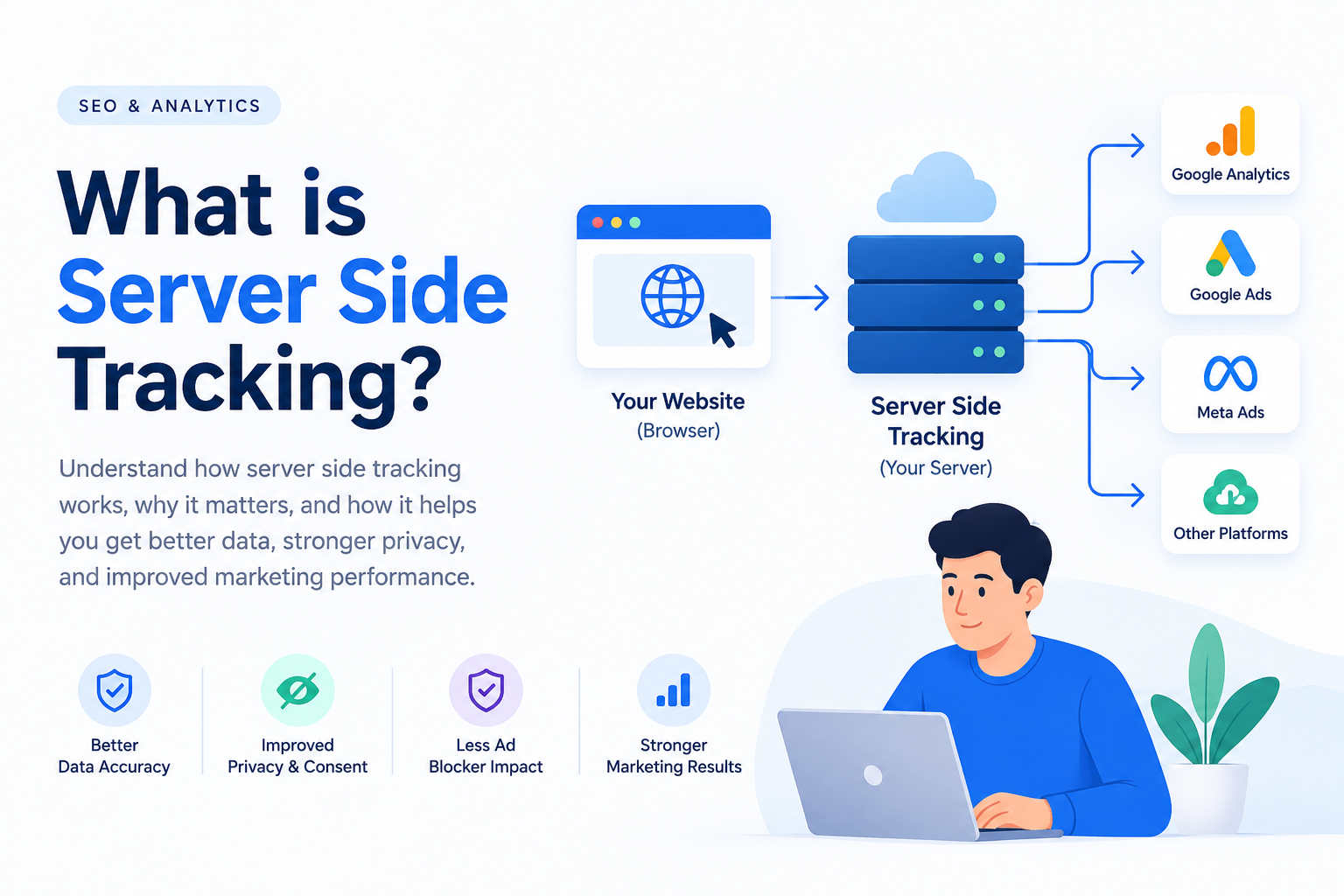
Server-side tracking, or server-side tagging, involves routing browsing and conversion data through an intermediary server before it reaches Google Analytics, Google Ads, or Meta, rather than sending it directly from the user's browser.
In practical terms, this means a change in the data route. The browser no longer communicates directly with dozens of third-party platforms: it transmits the information to a server that you control, which then redistributes it in a filtered and secure manner.
This architecture addresses a problem that has become structural for marketing teams: classic customer-side tracking is losing reliability, due to the cumulative effect of GDPR, ad blockers and browser restrictions on third-party cookies.
Client side tracking vs. server side tracking
To understand the importance of server-side tracking, we must first look at what is happening with client-side tracking, which is still the majority today.
With customer-side tracking:
- The user's browser loads a script (Google Analytics tag, Meta pixel, etc.)
- This script sends the data directly to the third-party platform.
- Each added platform is an additional script to load in the browser.
With server-side tracking:
- The browser sends a single request to a server that you host (a Google Tag Manager Server Side container, for example).
- This server processes the data, then redistributes it to Google Analytics, Google Ads, Meta, etc.
- Browsers and ad blockers only see a single call to your own domain, not a multitude of third-party scripts.
This distinction is not just a technical matter. It has direct consequences on the reliability of measured conversions, and therefore on the quality of decisions made based on this data: media budgets, channel choices, profitability management.
How exactly does server-side tracking work?
The most common architecture is based on Google Tag Manager Server Side (GTM Server Side). The principle:
- A client container , installed on the site, captures events (page views, clicks, conversions) and sends them to a server container, rather than directly to third-party platforms.
- A server container , hosted on a cloud infrastructure (most often Google Cloud Run), receives these events.
- This server container applies rules: data enrichment, filtering of sensitive information, distribution to the correct platforms.
- The data is then transmitted to the destination tools (Google Analytics 4, Google Ads, Meta Conversions API) via server-to-server connections, which are less exposed to blocking.
This shift in collection logic, from the browser to a server that you control, is what changes the game on three levels: reliability, compliance, and data security.
Why does server-side tracking improve measurement reliability?
Less impact from ad blockers and browser restrictions
Ad blockers and certain native browser features (like Safari's Intelligent Tracking Prevention) primarily target third-party domains identified as trackers. A server-side call, hosted on your own subdomain, is harder to identify and block than a typical third-party script. This doesn't make tracking invisible or "unblockable," but it significantly reduces data loss associated with such blocks.
Improved conversion quality for advertising algorithms
Platforms like Google Ads and Meta use the quality and volume of conversions received to optimize their automated bidding. Fewer lost conversions mean better-informed algorithms, and therefore more relevant media allocation. This is one of the most documented server-side use cases, particularly through advanced conversion APIs (Meta Conversions API, Google Ads Enhanced Conversions).
A stronger foundation for GDPR compliance
Server-side tracking does not replace consent management; a visitor who refuses cookies must still be respected, regardless of the technical architecture. However, it allows for the centralization and precise documentation of what data is sent, to whom, and under what conditions. Combined with Google Consent Mode v2, it offers finer control than a multitude of third-party scripts scattered throughout the website's code.
Limitations to be aware of before starting
Server-side tracking is not a magic bullet, and it would be dishonest to present it as such.
- It does not circumvent consent. If a user refuses tracking, the server-side must not and cannot legally continue to collect their data as if nothing had happened.
- It has infrastructure and maintenance costs. A container server needs to be hosted, monitored, and updated. It's not a "once-and-for-all" setup.
- It requires genuine technical expertise. A poor configuration can introduce new data discrepancies rather than resolve them.
- It does not address the underlying problems of a poorly structured tagging plan. Migrating a failing tracking system to a server-side architecture without revising the tagging plan is simply shifting the problem rather than solving it.
This is why a server-side tracking project always starts with an audit, not an implementation.
A concrete example: Octopus Energy
In Technetizens we support the octopus Energy, rebuilding the tracking system and migrating to server-side tracking were fundamental to the acquisition strategy, alongside SEO and paid advertising. The goal wasn't tracking for its own sake, but rather ensuring the reliability of the data transmitted to advertising algorithms, enabling them to accurately identify the value of acquired users.
This point illustrates an important reality: server-side tracking makes perfect sense when it is part of a global acquisition strategy, and not as an isolated technical project.
How do you assess whether your business should migrate to the server side?
Some questions to ask yourself before launching the project:
- Are you seeing significant discrepancies between the conversions measured by your advertising platforms and your actual business data?
- Is your media budget large enough for the quality of conversions passed to the algorithms to have a measurable impact?
- Is your current marking plan documented and understood by your teams, or is it based on poorly understood historical configurations?
- Do you have the internal or external resources to maintain a server infrastructure over the long term?
If the answer to the first or second question is yes, the subject warrants further investigation. If the answer to the third is no, an audit of the tagging plan should precede any migration.
Does server-side tracking replace Google Analytics or Google Ads?
No. It changes the way data arrives at these platforms, not the platforms themselves.
Is server-side tracking compatible with the GDPR?
Yes, provided it is configured in accordance with consent management (Consent Mode). It does not, under any circumstances, exempt users from respecting their choices.
Is server-side tracking necessary for all businesses?
No. It becomes relevant from a certain volume of conversions and media investment, when data quality has a direct impact on campaign performance.
How long does a migration to server-side tracking take?
This depends on the complexity of the existing tagging plan and the number of platforms to be reconnected. A preliminary audit allows for an estimation of the actual scope before committing to a timeframe.
To assess the reliability of your current tracking and the relevance of a migration to a server-side architecture, our tracking agency can carry out an initial diagnosis.
Also Read: https://technetizens-blog.webflow.io/posts/top-10-best-seo-experts-in-india