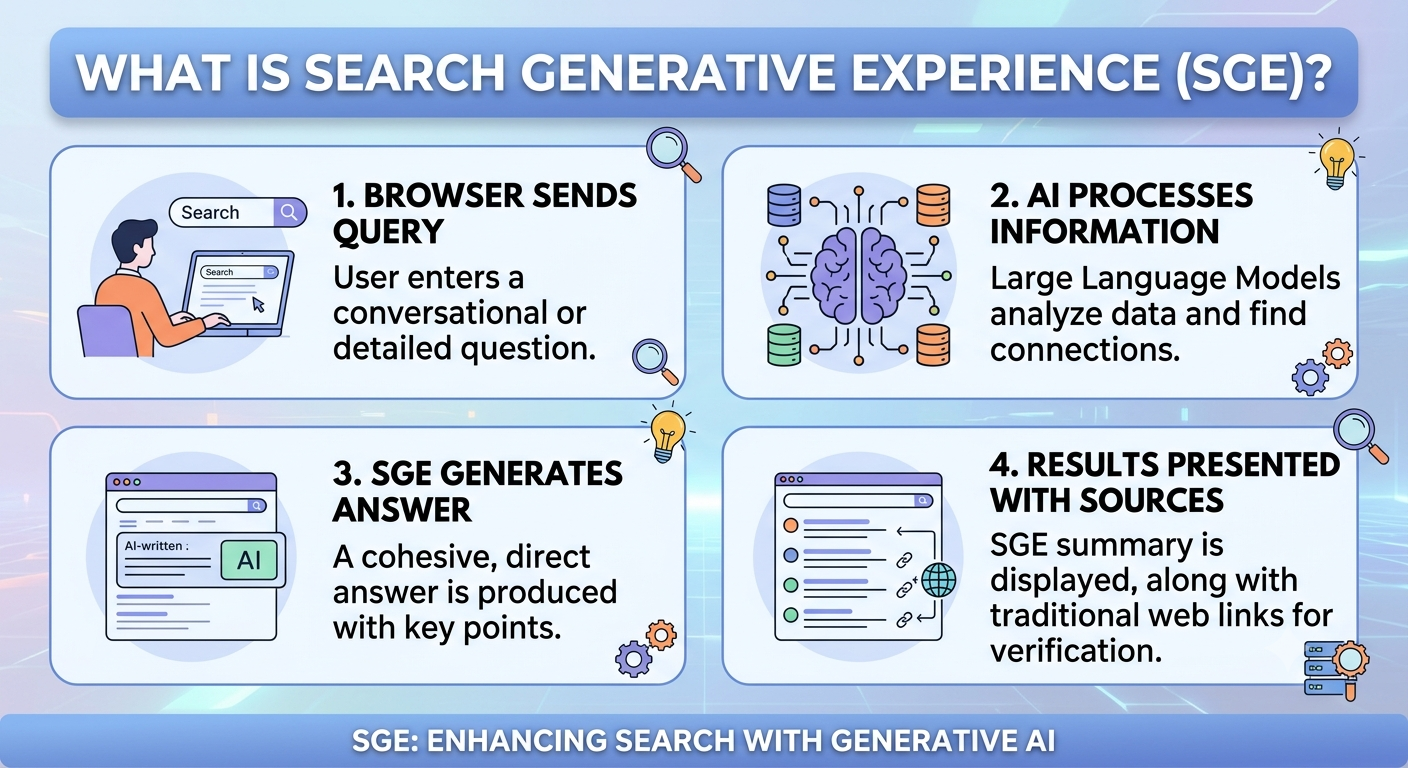
With the arrival of generative artificial intelligence at Google – and in particular Search Generative Experience (SGE) – the way search results are displayed is undergoing a radical transformation. For websites focused on SEO, this presents both a challenge and an opportunity. This turning point perfectly illustrates how Google is revolutionizing search with AI and redefining the rules of search engine optimization. In this article, we delve into these developments, their concrete impact on online visibility, and, most importantly, the technical and strategic levers to activate to remain competitive. Whether you own a website or work with a GEO agency , here are the keys to anticipating and capitalizing on this new landscape.
Also discover the challenges of SEO in the era of SGE and the opportunities to seize for B2B companies.
SERP changes under the influence of generative AI
Google is now integrating AI-generated summaries directly at the top of search results. Launching in 2023-2024, the AI Overviews from Google Search Console (GSC) provide a concise answer to the user's query, drawing on multiple web sources. This AI block appears before traditional organic results (and sometimes even before paid ads), solidifying Google's shift from a simple search engine to an "answer engine" focused on immediate information.
Fictional example: For a factual question like " Why is the sky blue? ", Google displays an AI-generated pop-up at the top of the page that directly provides the requested explanation. The user gets their answer without having to click on an external link. Furthermore, generative AI can integrate multimodal elements (images, videos) to enrich the answer, making the experience even more interactive and comprehensive right on the SERP itself.
These technological developments have resulted in a drastic decrease in the click-through rate (CTR) to websites. Approximately 60% of Google searches now result in no clicks to an organic result, as the user finds their answer directly on the page. In other words, nearly 6 out of 10 search queries result in zero clicks , compared to only about 44% a year ago (this is known as zero-click search ). The top organic results are relegated much further down the page: some organic listings that were once at the top of the page are now pushed back 1500+ pixels (the equivalent of 2 to 3 full screens) , forcing users to scroll extensively to see them. As a result, even a site ranked #1 loses a significant portion of its visibility, leading to a sharp drop in click-through rate (CTR) for otherwise well-positioned content. The rise of "direct answers" (optimized snippets, information panels, search engine results pages, etc.) thus reinforces the "zero-click" trend , where Google increasingly satisfies information needs within the search engine results page (SERP) itself.
Google's SGE is not yet available in France
The Search Generative Experience (SGE) has not yet crossed French borders. Since 2023, Google has been rolling out this new experience step by step: more than 120 countries already benefit from it, in dozens of languages, but France, like other European markets, remains on hold. Several reasons could explain this delay: constraints related to the GDPR, the need to adapt linguistic and cultural models, or even a strategic choice by Google, which prefers to refine its product before introducing it to a market as sensitive as France.
In practical terms, French internet users are still browsing a "classic" SERP: featured snippets, knowledge panels, People Also Ask… but not yet a generative block at the top of the page. However, signals coming from the United States, Asia, and certain European countries leave little room for doubt: Generative Search Engine (GSE) will arrive in France sooner or later. For publishers and SEO agencies alike, this period represents a real window of opportunity. Observing what's happening elsewhere now means gaining a head start to adjust strategies before the wave reaches our market.
Effects of AI on organic website traffic
For websites investing in SEO, the impact on organic traffic is already significant. Numerous studies anticipate a notable drop in traffic from Google due to these AI responses. For example, analyses conducted before the general rollout of AI Overviews predicted an 18% to 64% decrease in organic clicks, depending on the websites and topics involved. Major web advertising networks estimate a 20% to 60% drop in SEO traffic as generative AI becomes more widespread. In practice, since the introduction of AI Overviews in 2024, we are already seeing a decline in organic traffic for many informational queries, correlated with the increase in searches without clicks.
The types of sites and content most affected are those whose information can be easily summarized by AI. Guide pages , tutorials, definitions, or FAQs, which answer specific questions, are particularly vulnerable: Google can extract the essential information and present the answer directly in the search engine summary, thus overshadowing the corresponding organic links . For example, an affiliate site that relies on " Top 10 " or " Best X " comparisons risks having AI provide a summary of the best products/services directly in the search engine results page (SERP), drastically reducing clicks to that site. Similarly, publishers of encyclopedic or news content that attracted traffic through generic questions anticipate significant losses in visibility.
However, certain specific or sensitive queries seem less exposed to direct AI responses, at least at this stage. Google has been cautious on "Your Money Your Life" topics (health, finance, legal matters, etc.), and highly targeted transactional/local queries often continue to display traditional results (product pages, local packs, etc.) without systematic generative advertising. For example, commercial searches like "buy [product] near [city]" still rarely trigger a Generative Search Engine (GSE) block ( less than 5 to 10% of these queries are accompanied by an AI response ), instead favoring local or Shopping results. In fact, highly specific, local, or purchase-intent queries remain less covered by GSE to date , leaving untapped opportunities for organic traffic in these segments.
To go further, discover how to optimize your SEO in ChatGPT and generative engines to capture qualified traffic in the age of AI.
Furthermore, in complex fields (technical B2B, SaaS, medicine, specialized finance, etc.), many users remain somewhat wary of AI-generated answers and prefer to consult the sources in detail. It has been observed that internet users who click despite the presence of an AI summary are often those who want to delve deeper into the subject – a more qualified and engaged audience. These visitors, having already read the brief AI overview but wanting more , arrive with a strong intent, resulting in higher conversion rates – up to 10% in some cases of traffic originating from AI-generated searches. In short, while the volume of organic traffic decreases, the quality of the remaining traffic tends to increase (more decisive users seeking comprehensive information), which can partially compensate for the decrease in quantity.
It's also worth noting the brand awareness effect generated by AI-generated responses: even without a click, the presence of a website or brand name in a generated snippet can be valuable. Being cited as a source in a search engine results page (SERP) provides free brand visibility to internet users. They remember the website name appearing in the response, which may lead them to search for it directly or trust it later. Therefore, an SEO strategy in the age of AI must incorporate this dimension of visibility without clicks: success is no longer measured solely in visits, but also in impressions and impact on brand perception. As Google becomes increasingly capable of retaining users within its ecosystem (through instant answers or follow-up suggestions in SERPs), websites must find ways to thrive in these new information consumption patterns.
Technical recommendations for adapting your SEO to the age of AI
Faced with declining traditional organic traffic, SEO professionals must adapt their approach. The goal is twofold: to make content eligible for AI responses (to be cited or included in generative snippets) and to provide users with sufficient added value to encourage them to click nonetheless. Here are some concrete technical recommendations:
- Structure your content effectively and improve readability. Well-structured content is more easily understood and utilized by AI algorithms. Organize your pages with a clear hierarchy (using relevant H1, H2, and H3 headings), short paragraphs , bulleted lists or tables for key information, and ideally a FAQ section. This formatting helps search engine crawlers quickly extract concise answers from your pages. Furthermore, a fluid and natural text style is recommended: avoid keyword stuffing and heavy jargon; AI favors a conversational tone, similar to a human discussion. By making your content more readable and engaging (for both humans and machines), you increase your chances of being selected for an AI Overview and provide a positive experience for human visitors.
- Strengthen content quality and EEAT. More than ever, Google emphasizes the Experience, Expertise, Authoritativeness, and Trust (EEAT) of featured content. SGE responses rely on Google's usual ranking and quality systems, including Helpful Content and therefore EEAT. Be sure to demonstrate your expertise in each article: mention the author with their qualifications, provide a unique perspective , and integrate original data, case studies, or concrete examples from your experience. Support your claims with reliable sources (external links to reference sites, up-to-date statistics) to strengthen the credibility of your statements. Google highly values these signals of trust and authority, especially with SGE. In -depth, reliable, and high-value content is much more likely to be picked up by AI than basic or generic text. In short, write first to meet the user's needs in an expert manner, while providing algorithms with proof of your legitimacy (quotes, authoritative tone, highlighted experience).
- Anticipate related questions and cover the overall user intent. AI Overviews aim to give users everything they need to understand a topic , much like a super featured snippet . It's therefore strategic to "supercharge" your content by answering secondary questions that users might have after their initial search. Specifically, integrate elements like "People Also Ask..." or FAQs into your pages , covering variations and sub-questions related to the topic. Use Google's suggestions ( People Also Ask ), related searches, or even user forum questions. For example, a main article could include Q&A -style boxes to address these points. This approach allows you to satisfy the overall search intent , which will please the algorithm (content deemed complete and relevant) and increase your chances of being the source that AI cites for different facets of the topic. Furthermore, if a user views an AI response and then clicks on a follow-up question, your content could appear in those additional queries. In short, anticipate the conversation : content that responds "like a natural conversation" by seamlessly addressing subsequent needs will rank higher in the age of AI search.
- Use markup and structured data (Schema.org). It's crucial to provide context to search engines through structured data embedded in your pages. Schema tags help AI models better understand the content and entities present. For example, Google's Search Engine Results Page (SEG) relies in part on the Shopping Graph, which is powered by merchant data and indexed product pages. Therefore, be sure to add the appropriate schemas: Product (product page with price, reviews, stock, etc.), FAQ (formatted questions and answers), HowTo , Organization (information about your business), LocalBusiness for a local business, and so on. These tags provide Google with structured information that it can directly reuse in its search results. Well-tagged content (clear HTML titles, relevant JSON-LD microdata) will be "read" more effectively by Google's AI . In short, make the search engine's job easier by handing it your data: this increases your chances of being selected in a rich result or generative preview.
- Enrich your pages with media (images, videos, audio). Google's AI models are becoming multimodal , capable of interpreting not only text but also associated images or videos. Providing high-quality visual content on your pages can serve two purposes: firstly, AI can integrate these visuals into the snapshot (or use them as inspiration to validate an answer), and secondly, this media gives you visibility on other channels (Google Images, Google Videos) that are not yet saturated by generative AI. For example, an original diagram or infographic in your article can appear as a thumbnail illustration below the SGE block, encouraging the user to click on the image to enlarge it and thus visit your site. Similarly, a well-optimized explainer video could be featured in the video results. Enriching textual content with unique and relevant media improves the user experience and provides Google with additional material to analyze, strengthening your presence on the multi-format SERP.
- Optimize what AI still struggles with (local queries, transactional queries, mobile browsing, etc.). Since some query categories are less supported by generative responses, it's essential to redouble efforts on these remaining segments . For example, ensure excellent local optimization : an up -to-date Google Business Profile (opening hours, customer reviews, photos, etc.), LocalBusiness markup , and localized content—because local packs and "near me" searches remain highly click-generating in the absence of ubiquitous AI. Similarly, work on your high-intent purchase pages (products, services, quote requests): Google tends not to over-synthesize these commercial queries in Search Engine Results Pages (SGE), so this is an opportunity to capture maximum organic traffic on these high-converting keywords. In parallel, optimize all the standard technical aspects (loading speed, mobile compatibility, Core Web Vitals) to maximize your conversion rates when qualified visitors arrive – each click gained will be all the more valuable as opportunities are scarce. In short, focus your SEO efforts on strategic keywords not yet covered by AI to solidify these still-reliable traffic sources.
- Increase mentions of your site on third-party sources. Being present beyond your own website is an asset in an ecosystem where Google compiles answers from all over the web. Brand mentions, citations, and quality backlinks can indirectly drive traffic to the world of generative AI. In practice, Google can use a third-party article listing, for example, "the best apps for X" to create its AI summary – if your product or site is included, it will be mentioned in the answer. The user, seeing your name in the generative AI block, might click on it or perform a specific search. It is therefore beneficial to cultivate your overall digital presence : press relations to obtain citations in online media, guest post publications or downloadable content, partnerships to be featured in comparisons, etc. This "off-site" work will also improve your link profile (traditional SEO) while increasing the chances that your brand will be recognized by AI as an authority on a given topic.
By applying these optimizations, you increase your resilience to the decline in organic traffic. The central idea is to "become THE answer that AI chooses to summarize and source" rather than simply "be number one on Google." This represents a paradigm shift where the most useful, expert, and structured content dominates generative search results.
To delve deeper into these points, discover our SEO strategies to adopt in the face of AI to remain competitive in 2026.
Adapting your SEO strategy in the face of AI: towards sustainable and multi-channel SEO
Beyond purely technical aspects, the rise of AI in search necessitates a broader strategic shift for websites and brands. Here are the key strategic areas to prioritize:
- Diversify your traffic acquisition channels . Given Google's increased reliance on non-click results, it's risky to rely solely on traditional organic SEO. A multi-channel approach is essential . In practical terms, this means investing in other levers: social media, paid search (SEA), newsletters, content marketing on third-party platforms, podcasts, YouTube videos, and more. The goal is to reduce vulnerability to Google traffic loss by expanding your presence . As one analyst points out, the emergence of generative AI reinforces "the importance of a diversified brand presence, extending beyond the single [search] channel ." By building brand awareness across multiple platforms and fostering audience loyalty (through email subscriptions, online communities, etc.), you create direct touchpoints that compensate for the decline in Google visibility. In short, you have to think beyond the search engine: go find your audience where they are, rather than waiting for them to come to you on their own via an increasingly closed SERP.
- Focus SEO on the user and added value. More than ever, a user-centric strategy is essential. Google is no longer simply looking for pages optimized for its algorithms; it "chooses" content that can provide a genuine answer to the user's question. Therefore, it's crucial to create content designed primarily for the user experience —useful, up-to-date, and engaging—rather than clinging to outdated over-optimization strategies. "Don't aim to be first on Google anymore; aim to be chosen by AI. To achieve this, focus on excellent content, designed as a real answer for the user," perfectly summarizes the new philosophy. In practical terms, this means clearly understanding the intent behind each targeted query (informational, comparative, transactional, etc.) and answering it better than anyone else, going beyond the AI's generic response if possible. For example, for a query about a complex problem, providing personalized advice , exclusive data , or an expert perspective will help you stand out from the AI's standardized summary. The goal is to create value that AI cannot provide on its own – whether through creativity, human expertise, or depth of content.
- Build a strong and trustworthy brand. In the long run, brand strength will be a major defense against AI-driven disintermediation. If your site is recognized as a leader in its field, users will actively seek out your content (for example, by adding the site's name to their searches), and Google/AI will tend to prioritize you. Therefore, it's essential to invest in brand awareness and trust : cultivate your expert image (opinion leadership, media presence), encourage positive mentions, and maintain impeccable editorial consistency so that your name is synonymous with quality. A well-established brand presence increases the likelihood that your information will be used by AI models (via the Knowledge Graph, for example) and that users will click on you when they see you in the SERP. Even without clicks, appearing regularly in rich snippets improves brand recall, which can positively influence future purchasing or search behavior.
- Adopt Generative Experience Optimization (GEO). Some experts refer to GEO as the new frontier of SEO. This means aligning your strategies with how AI works: in addition to traditional SEO, consider how your content can be indexed, cited, and reused by AI itself. In practice: provide structured data, easily extractable content, concise answers on your pages (to facilitate copy/paste by AI), and ensure the veracity of your information (to avoid being filtered due to misleading content). This "post-SEO" optimization aims to make your content a building block of knowledge used by AI . It's a shift in perspective: no longer just pleasing the ranking algorithm, but serving as a source for the generative algorithm . Sites that master this will be highlighted by artificial intelligence, while others will disappear from the radar.
- Monitor developments and remain agile. Finally, it's essential to adopt a proactive approach of continuous monitoring and adaptation. Google is still refining its Search Engine Results (SER) (ongoing tests, adjustments related to AI hallucinations, user feedback, etc.). Therefore, it's crucial to measure the impact of these changes on your performance: track impressions and clicks per query in Google Search Console, identify those where the CTR drops abnormally (a possible sign that an AI response is capturing attention), test SERPs with SER for your strategic keywords in a lab environment or using tools, etc. SEO experts offer SER impact analysis models (e.g., Aleyda Solis, Moz) to assess the risk by page type. Use this data to adjust your strategy in real time : prioritize new content, reposition for less AI-competitive queries, improve sections of your pages deemed insufficiently high-quality, etc. The era of generative AI will be marked by constant evolution – only those who iterate rapidly based on signals will retain an advantage.
Also, keep an eye on Google's latest features and their impact on traffic to anticipate future changes.
In summary, Google's increased use of generative AI is a turning point for SEO. It's no longer simply about optimizing pages for the ranking algorithm, but about producing content that can be understood, selected, and even reproduced by AI . This necessitates raising the bar for content quality and relevance, while rethinking visibility strategies beyond traditional SEO. Websites and agencies that successfully navigate this transition will also see opportunities: less low-quality competition (eliminated by AI), more qualified traffic, and the chance to strengthen their brand image by becoming preferred sources of information.
Summary of SEO recommendations by domain
The following table summarizes the main technical and strategic recommendations regarding generative AI, classified by major areas of optimization:
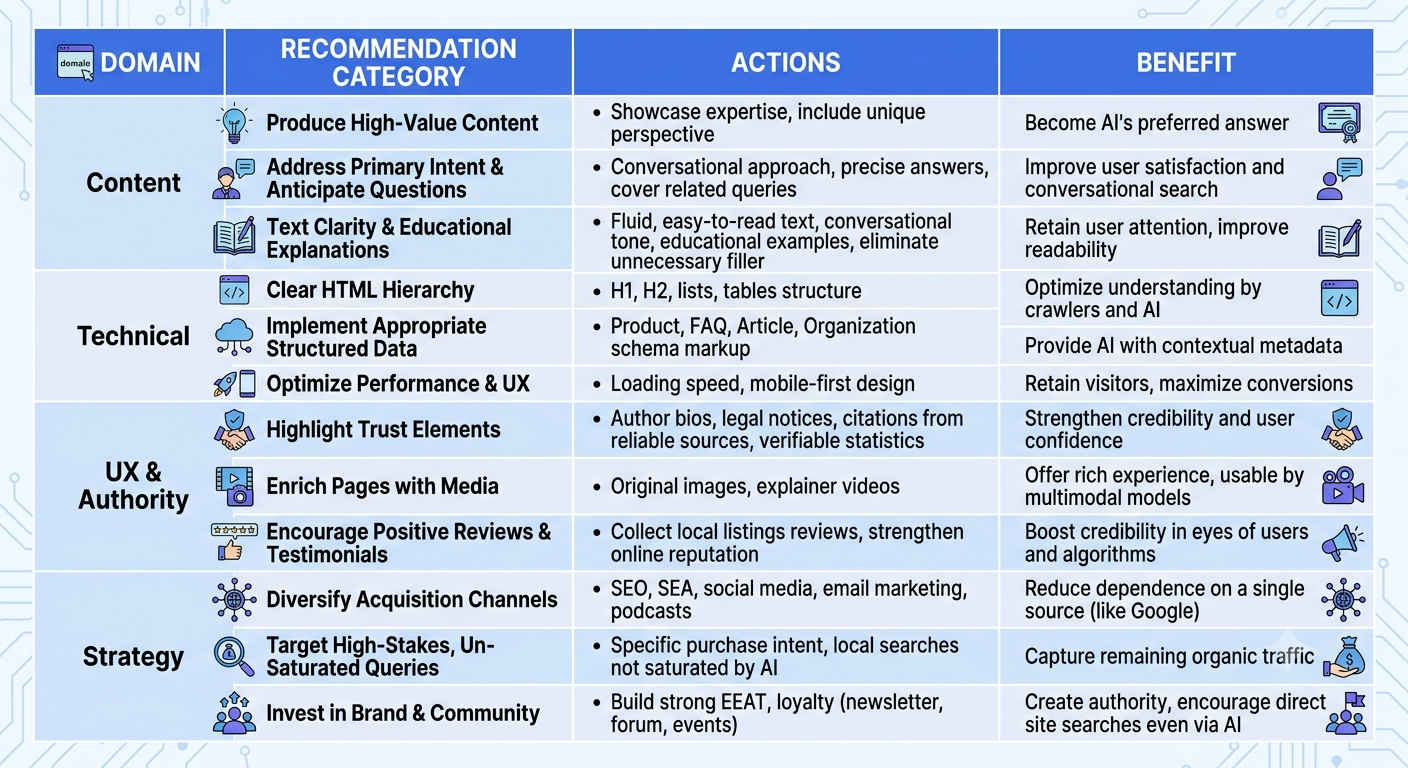
By applying these recommendations, websites can survive and thrive in the new search environment dominated by generative AI. While generative SEO certainly represents a game-changer for SEO, it can also become an opportunity for businesses that prioritize quality, innovation, and user-centricity . By evolving towards augmented SEO (or "SEO 2.0") adapted to AI engines, it's possible to maintain visibility and even widen the gap with less responsive competitors. In conclusion, the key is adaptation : those who quickly integrate these changes—creating excellent content, optimizing for AI, and implementing a multi-channel strategy—will continue to leverage search, in its new form, to generate qualified traffic and sustainable business results.
Partner with the best SEO agency to ride the generative SEO wave!
Advertising and SGE: AI is also transforming SEA
The arrival of Search Generative Experience isn't just revolutionizing organic search engine optimization (SEO): it's also changing how paid ads appear in Google. Ads are now integrated directly around—and sometimes inside —generated content blocks (AI Overviews and AI Mode). Specifically, Google displays ads above and below AI-generated content, but can also offer relevant ads within the generated summary itself .
These ads take into account not only the user's query but also the content generated by AI. For example, if a user asks for "best hiking shoes for beginners," the generative ad unit can offer a concise answer and, right next to it, display Shopping or Search ads targeting specific products. This shortens the path to purchase and captures attention at the precise moment intent is formed.
The advertising formats concerned include:
- Text Ads (classic Search ads),
- Shopping Ads (from product feeds),
- Local & App Ads (local campaigns and applications),
- as well as Performance Max (PMax) campaigns , which benefit from native integration into AI experiences
For advertisers, this implies two major changes:
- Increased automation : Google recommends using its AI-driven targeting solutions (Broad Match, AI Max for Search, Performance Max, etc.), which are capable of going beyond traditional keywords and covering emerging queries thanks to a better understanding of language and intent.
- A stricter requirement for the quality of product feeds : for retailers, Google emphasizes the importance of feed hygiene , meaning keeping Shopping feeds perfectly up-to-date (prices, availability, images) in order to be eligible for integrations into the SGE (Sales Platform).
In short, AI doesn't make ads disappear; on the contrary, it repositions them at the heart of the user experience, precisely when users are exploring a topic and about to take action. For brands, this means that search engine advertising (SEA) remains a key lever—but it must be rethought in light of these new placements, increasing automation, and synergy with generative content.
Also Read- https://technetizens-blog.webflow.io/posts/what-is-server-side-tracking
Also Read: - https://technetizens-blog.webflow.io/posts/top-10-best-seo-experts-in-india